Download the questionnaire and submit it to us
info@torch-air.com



Made in the USA
Scan the QR code or click on it to start a chat in WhatsApp




Performance: up to 18 000 cfm (30 000 m³/h)
No continuous liquid circulation; optional periodic wash-down. All characteristics
Price: by request depending on the package


5-Year guarantee
Easy installation and operation
Over 10 years of service life
Eco Friendly
GET COST AND TIME ESTIMATE
Obtain the cost and timeline for the equipment’s delivery
By filling out this form, you agree to our personal data processing policy
HURRICANE Mist Eliminator
Two-Stage Separation for Chemical, Oil and Coolant Mist
Cleans up to 99.9% waste, dust, flue and exhaust gases, depending on the level of pollution

Mist Eliminator Description
HURRICANE is a vertical mist eliminator for separating entrained liquid droplets from industrial exhaust. It combines an initial droplet-separation stage with a coalescing demister stage to reduce liquid carryover. The separated liquid collects in a lower hopper and leaves through a drain connection.
The unit can be selected for compatible chemical, oil, coolant or water mist. Gas enters through a lower side connection and moves upward through the separation stages before leaving through the top outlet. Materials and media are matched to the liquid chemistry, droplet loading and operating temperature.
HURRICANE can be supplied as a separator or integrated with a fan, ductwork and controls. A continuously recirculating liquid circuit is not required for the basic separation process. Periodic wash-down is available where the deposit can be washed and the collected liquid can be drained appropriately.
The unit can be selected for compatible chemical, oil, coolant or water mist. Gas enters through a lower side connection and moves upward through the separation stages before leaving through the top outlet. Materials and media are matched to the liquid chemistry, droplet loading and operating temperature.
HURRICANE can be supplied as a separator or integrated with a fan, ductwork and controls. A continuously recirculating liquid circuit is not required for the basic separation process. Periodic wash-down is available where the deposit can be washed and the collected liquid can be drained appropriately.

Two-stage collection
The first stage reduces the larger-droplet load before the gas reaches the finer coalescing media.
Gravity drainage
Captured droplets combine and drain to the lower hopper for collection, disposal or compatible process return.
Downstream equipment protection
Reducing liquid carryover helps limit deposits and liquid loading in fans, ducts and subsequent treatment stages.
HURRICANE Benefits
Systems and Service

Access arrangements allow inspection, cleaning and replacement of the collecting elements.
The vessel, initial separator, mesh and seals are selected for chemical compatibility and operating conditions.
Individual separators or parallel systems can be arranged for the flow and number of process exhaust lines.
Service access
Project material options
Single or multiple units
Two Separation Stages
Stage 1 — vane droplet separator
Intercepts larger droplets and reduces the liquid loading on the demister. Reference construction: PVC vane element, 5.1 in (130 mm).
Lower side inlet, top outlet
Mist-laden gas enters the lower part of the vessel and rises through both stages to the upper outlet.

Stage 2 — mesh demister
Fine droplets contact the mesh, combine and drain. Reference construction: AISI 304 mesh, 3.9 + 5.9 in (100 + 150 mm) on a 2.0 in (50 mm) support grid.
Gravity drainage to the hopper
Separated liquid flows down to the conical hopper and drain connection.
Negative-pressure service
Intended for operation under negative pressure unless specifically engineered otherwise.
HURRICANE Configurations
-1-
Single unit
A separator for an individual exhaust line with project-specific support and drain arrangements.
-2-
Parallel system
Multiple units for separate process lines or a higher combined flow. Flow distribution is included in system engineering.
-3-
Integrated system
Separator, selected fan, ductwork and instrumentation supplied within the agreed scope.
Spheres of Use
HURRICANE is selected for compatible chemical, oil, coolant and water mist from industrial processes.
- Machining and metal cuttingCompatible oil and coolant aerosols from machine tools and CNC operations.
- Grinding and die castingLiquid mist separation where the selected media can accommodate the accompanying solids and deposits.
- Chemical and surface treatmentCompatible chemical droplets from processing, metal finishing and industrial washing.
- Other process mistWater and process-liquid carryover, including suitable food-processing duties with application-specific materials.
HURRICANE separates liquid droplets. It does not remove oil vapor, gas-phase acids or gaseous odors by itself. Fine smoke and submicron aerosols may need another polishing technology.
The Working Principle of HURRICANE Mist Eliminator
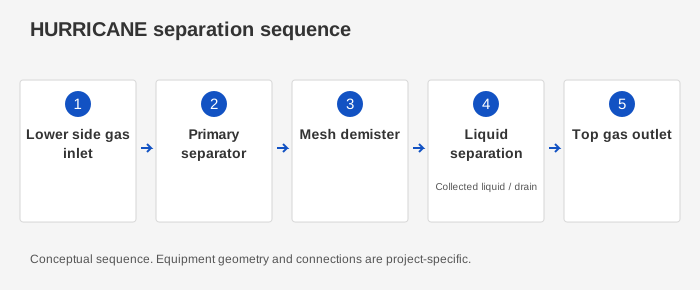
1. Lower side inlet. Mist-laden gas enters the lower part of the vessel through the side inlet.
2. Primary droplet separation. The first collecting stage intercepts larger droplets and reduces loading on the downstream demister.
2. Primary droplet separation. The first collecting stage intercepts larger droplets and reduces loading on the downstream demister.
3. Fine mist coalescence. The gas rises through the mesh. Captured droplets merge into larger drops on the collecting surfaces.
4. Gravity drainage. Liquid drains downward into the lower hopper and exits through the drain connection.
5. Top gas outlet. The gas leaves through the upper outlet after passing through the selected separation stages.
4. Gravity drainage. Liquid drains downward into the lower hopper and exits through the drain connection.
5. Top gas outlet. The gas leaves through the upper outlet after passing through the selected separation stages.

Stage 1: vane separator

Stage 2: mesh demister
Illustrations. Reference construction may change with the application.
Specifications
The model table gives catalog reference maximum flows, not a guaranteed operating range or a minimum stable flow. Actual CFM must correspond to the operating gas temperature and pressure. Reference construction may change with the application.
HURRICANE Reference Models
Model capacities and connections are catalog reference values. Final dimensions, materials and connection details are confirmed in the project drawings.
CFM values are unit conversions rounded to the nearest whole number; they do not standardize the gas to standard temperature or pressure.
CFM values are unit conversions rounded to the nearest whole number; they do not standardize the gas to standard temperature or pressure.
Package
Basic package
The basic package is defined by the selected model and the agreed arrangement.
Vessel with primary and coalescing stages
1
Media supports and service access
Set
Lower collection hopper with drain connection
1
Gas inlet, outlet and supports
Set
Project drawings and operating documentation
Set
Additional package elements
Options are selected with the client according to the mist, the deposit and the plant interface.

MANAGEMENT AND CONTROL
- Periodic wash-down with manual, timer or PLC control
- Differential-pressure indication, sampling ports and alarms
- Plant control interface

DESIGN AND FILTER
- Fan with variable-frequency drive, ductwork and stack
- Custom materials, media and additional mist stages
- Support steel, platforms, ladders and service access
- Downstream particulate or vapor polishing by separate engineering selection
Modifications and Sizes
The reference range covers HURRICANE 60 to HURRICANE 300 with maximum model flows from 6,000 to 30,000 m³/h (3,531–17,657 CFM). Each unit is sized for its duty.
For several process lines or a higher combined flow, units are arranged in parallel. Special materials, sizes and configurations are available.
Overall dimensions and weights are issued in project-specific certified drawings before fabrication.
For several process lines or a higher combined flow, units are arranged in parallel. Special materials, sizes and configurations are available.
Overall dimensions and weights are issued in project-specific certified drawings before fabrication.
Separator Design
The HURRICANE vessel has a lower side gas inlet, a primary vane droplet separator, a coalescing mesh demister on a support grid and a top gas outlet. Separated liquid collects in a conical hopper with a drain connection. Service access allows inspection, cleaning and replacement of the collecting elements; spray headers can be added for periodic wash-down.
Operation and Maintenance
Inspect pressure drop, media condition and drainage. Remove accumulated liquid and deposits using the prescribed service procedure. Washing must suit the oil or chemical collected; water alone is not appropriate for every duty.
Check for blocked drains and damaged seals or media before returning the separator to service.
Engineering notes:
- HURRICANE units are intended for operation under negative pressure unless specifically engineered otherwise.
- Re-introduction of separated air into an occupied workspace requires a separate application review.
- Final efficiency depends on droplet size, loading, gas properties, media selection and operating conditions.
Other Products

Get a Consultation From One of Our Factory's Experts
Michael
Klepik
Klepik
Chief Executive Officer
Consults and provides calculations
Consults and provides calculations
Vladimir
Nikulin
Nikulin
Chief Technology Officer
Head of development and design
Head of development and design
+1 (918) 406-5684
info@torch-air.com
+1 (918) 406-5684
info@torch-air.com
DELIVERY AND INSTALLATION ALL OVER USA, CANADA, MEXICO
FULL ADHERENCE TO QUALITY STANDARDS
WE CUSTOMIZE INSTALLATIONS TO SUIT YOUR COMPANY
FAVORABLE PRICES FROM A US MANUFACTURER